Lawn Care
Booking Christmas Light Installation in Midlothian
TW Lawn Care • September 2026 • Midlothian, TX • 8 min read
Short Answer: Holiday lighting is one of the most compressed service seasons there is. Nearly every customer wants their lights on within the same three or four week window, and a crew can only complete a limited number of homes per day. The calendar is largely allocated by early autumn, and the best installation dates go first. Booking in September gets you a real design conversation, a choice of dates, and time to order materials. Calling in mid November means taking whatever remains, if anything does.
It feels early to think about Christmas lights while it is still warm in Ellis County. That is exactly why it is worth writing about now.
The pattern repeats every year without fail. Quiet enquiries in September, steady in October, and then a wave of calls the week after Thanksgiving from people who assumed there would be time.
The Season Is Genuinely Short
The arithmetic from the installer's side explains everything else.
Most households want their lights on somewhere between mid November and the first week of December. That is a window of roughly three weeks. A crew can complete a certain number of homes per day, and a properly executed roofline install is not a fifteen minute job.
Multiply working days in that window by daily capacity and you get a fixed number of houses. It is not a number that flexes, because you cannot manufacture more November.
Weather takes days out of it as well. Crews work at height, and when there is rain, ice, or high wind they come down, which is not negotiable. North Texas can deliver a genuinely nasty stretch in late November, and every lost day compresses what is left.
A booking made in September sits in a schedule that still has slack to absorb lost days. A booking made in late November sits in one that does not.
What September Buys You
Availability is the obvious benefit. The more valuable one is time to think.
A design conversation now can happen without pressure. We can look at the house, discuss which lines to emphasize, consider how it reads from the street, and talk about what you actually want it to feel like. That is a different conversation from one held over the phone in late November while a crew waits.
Materials matter too. Specific colors, C9 versus mini bulbs, particular lengths, and any custom elements are ordered rather than pulled off a shelf, and lead times are real.
If your project needs any electrical work, an outlet added near the roofline or a circuit assessed, that coordination takes time nobody has in the last week of the month.
What a Professional Install Includes
Worth knowing what you are buying, because it is more than hanging lights.
A proper service generally covers design, commercial grade materials supplied by the installer, installation, maintenance through the season if a run fails, and takedown and storage afterward. That last part is a larger share of the value than people expect, because taking lights down in January is the job nobody wants.
Ask specifically what happens if a section goes out in mid December. A service that installs and disappears is a different product from one that maintains through the season.
Ask about the materials as well. Commercial grade product handles our weather considerably better than retail strings, and it is one reason a professional install costs what it does.
And ask about storage, since a company that stores your lights between seasons removes a genuine hassle and protects the product from a hot Texas attic.
Design Decisions Worth Making Early
A few choices shape the result more than anything else, and they are easier to consider now.
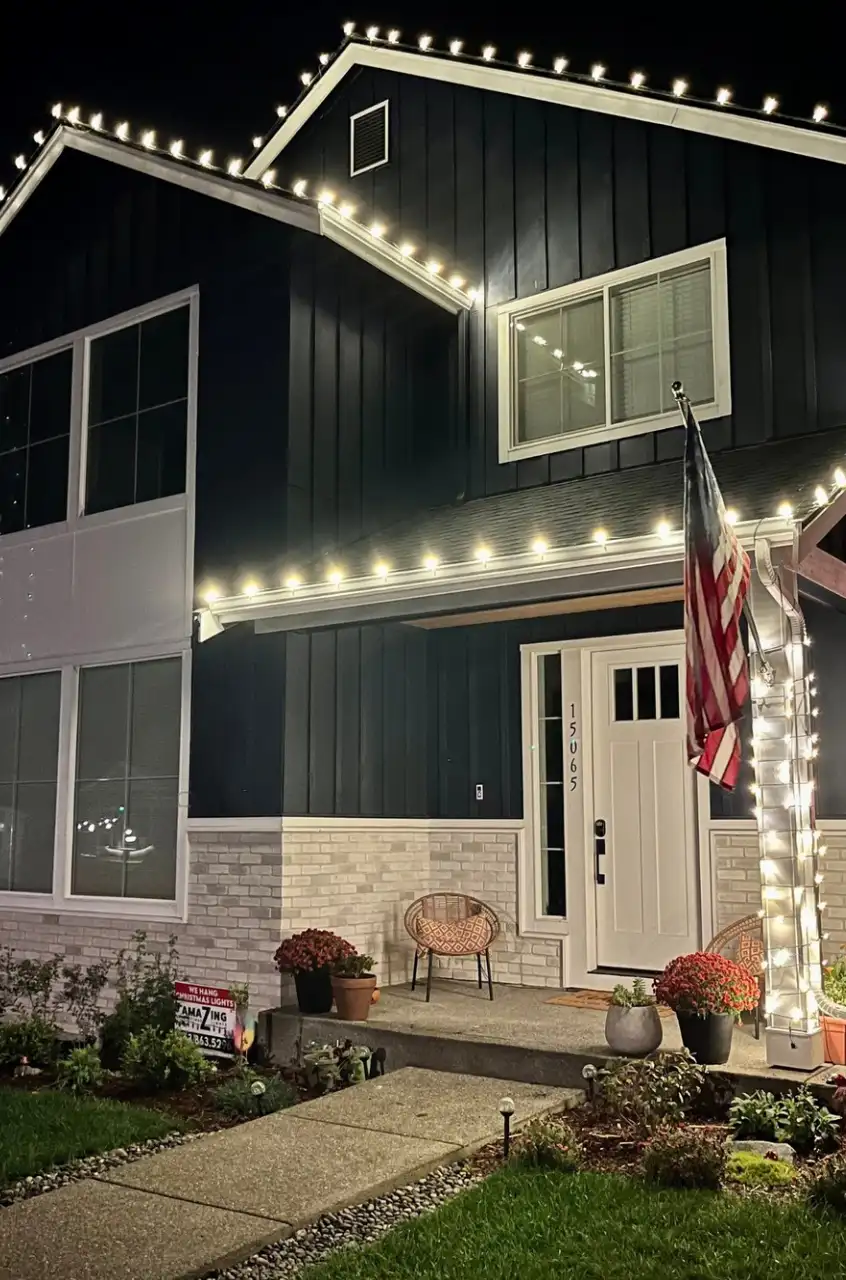
Warm white versus cool white is the biggest one. Warm white reads traditional and complements brick and stone, which describes most of Ellis County. Cool white reads crisp and modern. Mixing them accidentally is the most common way an otherwise good install looks slightly off.
Roofline only, or roofline plus trees, columns, and landscape features? Roofline alone is clean and effective. Adding a few well chosen accents usually improves it more than extending the roofline further around a side nobody sees.
And think about what the house looks like from where people actually see it, which is usually the street rather than the driveway. Lighting a run that faces a fence line costs the same as lighting one that faces the road.
Safety Is a Real Part of This
We would rather say this plainly than let it go unsaid.
Every year people are injured putting up holiday lights, and the pattern is consistent: ladders on uneven ground, steep roofs, working alone, and rushing in cold weather. Two story homes and steep pitches are where it gets serious.
If your house is single story with easy access and you enjoy doing it, that is a perfectly reasonable choice. If you have been putting off replacing that ladder, or the roof pitch makes you uneasy, that is worth weighing against the cost of an install.
Electrical load matters too. Older homes with limited exterior outlets can be pushed past what a circuit should carry, and that is worth assessing rather than discovering.
What It Costs and What Moves the Number
Pricing varies enough that a firm figure without seeing the house would be a guess, but it is worth knowing what actually drives it.
Linear footage of roofline is the foundation, in the same way square footage drives lawn pricing. Beyond that, height and access matter a great deal. A single story with clear access is straightforward. A two story with steep pitch, or a roofline that can only be reached over landscaping, takes considerably longer and requires more equipment.
Complexity adds up as well. Multiple peaks, dormers, and varied rooflines all take more time than a single clean run, and wrapping columns, trees, or landscape features is separate work from the roofline itself.
Whether materials are included and stored between seasons is the other large variable, and it is why two quotes can differ substantially for what sounds like the same job. A price that excludes takedown is not comparable to one that includes it.
Ask for the quote to state roofline footage, what accents are included, whether materials are supplied and stored, whether mid season maintenance is covered, and whether takedown is in the price.
Why Returning Customers Fill the Calendar
A practical note on how availability actually works.
Most companies in this business, ourselves included, work with a substantial number of returning customers, and those homes are often confirmed early. The design is done and the materials are known, so they are straightforward to schedule.
What that means for a new customer is that the pool of genuinely available capacity is smaller than the total and is claimed earlier. If this would be your first installation, that is the reason to have the conversation now rather than after you have seen a neighbor's lights go up.
Permanent Lighting Is a Different Conversation
Worth mentioning because people increasingly ask, and the two options solve different problems.
Seasonal installation means lights go up in November and come down in January, and you get a fresh design each year with no hardware on the house the rest of the time. It is the right answer for most households and it is what the large majority of our lighting customers want.
Permanent architectural lighting means track mounted along the roofline that stays year round, controlled from an app, running warm white on ordinary evenings and changing color for holidays and events. The hardware is visible in daylight to some degree, which is the trade off, and the up front cost is considerably higher.
The way to think about it is how many evenings a year you want the house lit. If the answer is genuinely only December, seasonal installation is better value and leaves nothing attached to the house. If you would use it for Halloween, game days, and ordinary evenings as well, the arithmetic shifts.
Either way the decision is easier made in September than in the week after Thanksgiving, because permanent systems involve materials, design, and an installation day chosen for good weather.
What to Do Next
Stand across the street from your house at dusk this week and look at it the way a visitor does. Note which lines your eye follows and which features disappear at night.
Take a photograph from that spot. It is more useful in a design conversation than a folder of images from elsewhere, because it shows your actual house from the angle that matters.
Then decide roughly what you want covered and get on the calendar. TW Lawn Care handles Christmas light installation alongside lawn and landscape services across Midlothian, Waxahachie, Cedar Hill, Mansfield, Red Oak, Ovilla, and Ellis County. Call 972-757-0926 or visit twlawncareservices.com.
Here is what to expect. We will look at the house rather than quote from a template, tell you honestly what suits your architecture, and give you an installation window along with what happens if a run fails in December. If we are already full for the dates you want, we will say so rather than letting you find out late.